
Classic Car Nuts & Bolts – A Guide to Imperial and Metric Threads
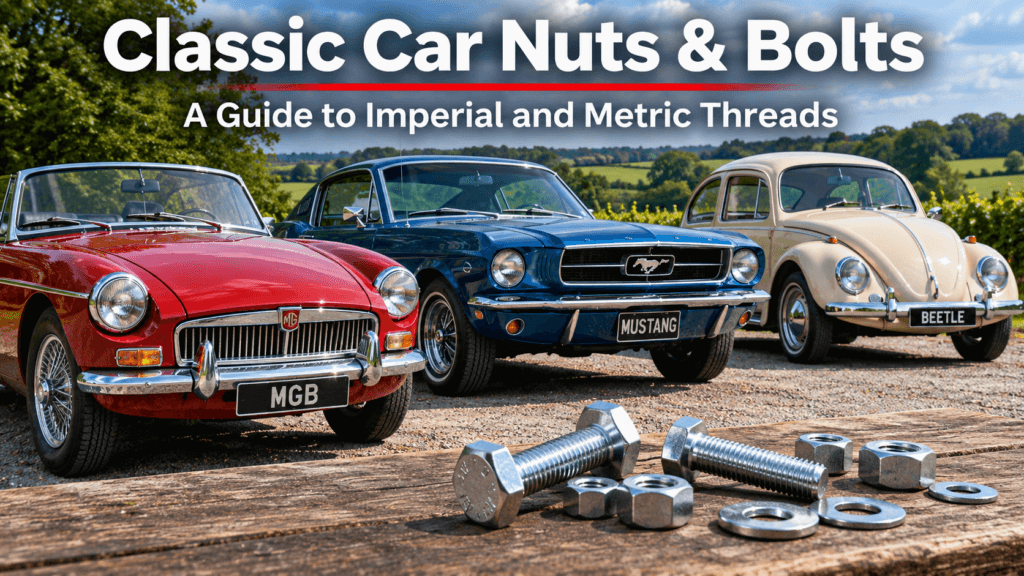
Restoring or maintaining a classic car often means tracking down nuts, bolts and fasteners that are no longer commonly available. Whether you’re working on an MGB, Morris Minor, Triumph, classic Mini, Ford Mustang or Volkswagen Beetle, identifying the correct thread type can sometimes be a challenge.
But which thread types are commonly found on classic cars?
We’ve put together this general guide to help you understand the different thread standards associated with popular British, American and European classics.
Important: Classic vehicles can contain several different thread types. Specifications may vary depending on the year of manufacture, engine, component and previous repairs. This guide provides general information rather than definitive vehicle specifications. Always verify the original thread before ordering replacement fasteners.
What Threads Were Used on British Classic Cars?
British car manufacturers used several different thread standards throughout the twentieth century.
Earlier vehicles commonly featured British Standard Fine (BSF), British Standard Whitworth (BSW) and British Association (BA) threads. As the British motor industry adopted Unified thread standards, UNF and UNC became increasingly common.
The transition wasn’t immediate, and many classic cars contain a mixture of thread types.
Popular British Classic Cars and Their Threads
| Classic car | Approximate production years | Thread standards you may encounter |
|---|---|---|
| MG MGB | 1962–1980 | Predominantly UNF, with UNC and smaller specialist threads |
| MG Midget | 1961–1979 | Commonly UNF and UNC, with some BA and other component-specific threads |
| MG TC, TD and TF | 1945–1955 | BSF, BSW, BA and special historical metric engine threads; some later Unified fittings |
| Morris Minor | 1948–1971 | BSF, BSW, UNF, UNC and other threads depending on component and production period |
| Classic Mini | 1959–2000 | Unified threads widely encountered, with metric and other exceptions |
| Austin-Healey 3000 | 1959–1967 | Commonly Unified threads, with specialist fittings |
| Triumph TR2–TR6 | 1953–1976 | Unified threads widely encountered, with variations between models |
| Triumph Spitfire | 1962–1980 | UNF and UNC, with component-specific exceptions |
| Jaguar E-Type | 1961–1975 | Unified and specialist threads depending on the assembly |
| Jaguar Mk2 | 1959–1967 | Unified threads and other specialist fittings |
| Land Rover Series I–III | 1948–1985 | Predominantly imperial thread standards, with differences between production years and components |
| Ford Escort Mk1/Mk2 | 1968–1980 | Unified threads common on Mk1; increased metric use on Mk2, with some Unified components retained |
| Ford Cortina | 1962–1982 | Unified and metric threads may be encountered, depending on generation |
| Rover P4/P5 | 1949–1973 | British Standard and Unified threads may be encountered, depending on model |
These are general indications of thread families, not complete vehicle specifications. Always check the individual fastener and relevant workshop manual.
For restorers working on older British vehicles, Arun Fasteners stocks BSF hex bolts and setscrews alongside UNF bolts and setscrews in a variety of sizes.
Why Do British Classic Cars Have Different Thread Types?
During the twentieth century, British manufacturers gradually moved away from older British Standard threads towards Unified threads, which helped standardise fasteners across British and American manufacturing.
However, this change took place over many years.
A classic vehicle may therefore have UNF fasteners on some mechanical assemblies, UNC threads in certain cast components, and older British Standard or specialist threads elsewhere.
Replacement engines, aftermarket components and decades of repairs can introduce further variations.
For example, early MG T-Series cars can contain special historical metric engine threads with Whitworth-sized hexagon heads. These are not necessarily interchangeable with modern metric threads. This demonstrates why the size of the spanner used to remove a bolt does not identify its thread.
Similarly, Ford Escort Mk1 and Mk2 vehicles illustrate the transition towards metric fasteners. The Mk1 commonly used Unified threads, while metric fasteners became more widespread on the Mk2. Some components retained imperial threads, so the model alone cannot establish the correct specification.
This is why identifying the thread on the actual component is always preferable to assuming that every fastener on a particular vehicle follows the same standard.
What Threads Were Used on Classic American Cars?
Classic American vehicles are strongly associated with Unified National threads.
The two most commonly encountered standards are:
- UNC (Unified National Coarse): A coarser thread commonly found in many automotive applications.
- UNF (Unified National Fine): A finer thread frequently used in automotive and engineering assemblies.
Many American vehicles manufactured during the 1950s, 1960s and 1970s use both standards, although individual components and later replacement parts may differ.
Popular American Classic Cars
| Classic car | Approximate production years | General thread information |
|---|---|---|
| Ford Mustang (first generation) | 1964–1973 | UNC and UNF commonly encountered |
| Ford Thunderbird (early generations) | 1955–1971 | Unified threads commonly used |
| Chevrolet Bel Air | 1950–1975 | Unified threads common on many assemblies |
| Chevrolet Camaro (first generation) | 1967–1969 | UNC and UNF commonly associated with these vehicles |
| Chevrolet Corvette C1–C3 | 1953–1982 | Unified threads common, with component-specific exceptions |
| Chevrolet Chevelle | 1964–1977 | UNC and UNF commonly encountered |
| Dodge Charger (early generations) | 1966–1978 | Unified threads commonly used |
| Dodge Challenger (first generation) | 1970–1974 | Unified threads commonly used |
| Pontiac Firebird (early generations) | 1967–1981 | Unified threads widely used |
| Plymouth Barracuda | 1964–1974 | Unified threads commonly encountered |
These are broad indications for classic American vehicles, not complete fastener specifications. Individual components and replacement parts may use different threads.
Arun Fasteners stocks a selection of UNC hex bolts and setscrews as well as UNF socket screws in various head styles and sizes.
UNC or UNF – Which Is More Common on American Cars?
Both standards are widely associated with classic American vehicles, but they are not interchangeable.
For example, a 3/8″ UNC fastener has 16 threads per inch, whereas a 3/8″ UNF fastener has 24 threads per inch.
Although the nominal diameter is the same, the threads are different.
When restoring an American classic, always check the thread pitch as well as the diameter before purchasing a replacement.
What Threads Were Used on European Classic Cars?
Many continental European manufacturers adopted metric thread standards much earlier than British and American manufacturers.
As a result, metric fasteners are commonly found on classic Volkswagen, Porsche, Mercedes-Benz, BMW, Fiat and Alfa Romeo vehicles.
Both standard metric coarse and metric fine threads may be encountered.
Popular European Classic Cars
| Classic car | Approximate production years | General thread information |
|---|---|---|
| Volkswagen Beetle | 1938–2003 | Predominantly metric, including fine-pitch applications |
| Volkswagen Type 2 Camper (early generations) | 1950–1979 | Predominantly metric |
| Porsche 356 | 1948–1965 | Metric threads and specialist fittings |
| Porsche 911 (early generations) | 1964–1989 | Metric threads, including fine-pitch applications |
| Mercedes-Benz W123 | 1976–1986 | Metric threads, including fine-pitch applications |
| Mercedes-Benz SL W113 | 1963–1971 | Predominantly metric |
| BMW 2002 | 1968–1976 | Metric threads |
| BMW E30 | 1982–1994 | Metric threads, including fine-pitch applications |
| Fiat 500 (original) | 1957–1975 | Metric threads with component-specific exceptions |
| Alfa Romeo Spider (classic generations) | 1966–1993 | Metric threads, including fine-pitch applications |
European vehicles can also contain specialist fittings and manufacturer-specific fasteners. Not every metric bolt of the correct diameter is a suitable replacement.
Arun Fasteners supplies a wide range of metric hex bolts and setscrews and metric socket screws, including different materials, finishes and strength grades across selected ranges.
Why Identifying Classic Car Fasteners Can Be Difficult
Even when you know the manufacturer and year of your classic car, identifying the correct fastener isn’t always straightforward.
1. Manufacturers used more than one thread standard
Different components could be manufactured using different thread types, even on the same vehicle.
2. Thread standards changed over time
Manufacturers gradually adopted new standards, sometimes during a model’s production run.
3. Engines and components may have been replaced
An engine fitted during a previous restoration may not be original to the vehicle.
4. Imperial threads can look very similar
UNC, UNF, BSF and Whitworth fasteners can have similar nominal diameters but different pitches or thread forms.
5. Spanner size doesn’t identify the thread
The size of the hexagon head does not necessarily tell you which thread standard is used. This is especially important with older British vehicles.
6. Material and strength matter too
Matching the thread size alone is not always sufficient. Fastener grade, material, length and application are important, particularly on safety-critical assemblies such as steering, suspension and braking systems.
Never substitute a different fastener grade or material without confirming that it meets the manufacturer’s requirements.
How to Identify an Unknown Classic Car Bolt
If you’re unsure which thread your vehicle uses, a few simple checks can help.
- Measure the outside diameter of the bolt using a vernier caliper.
- Check the thread pitch using a suitable thread pitch gauge.
- Determine whether the thread is imperial or metric. Imperial threads are generally measured in threads per inch (TPI), while metric pitch is measured in millimetres.
- Compare the thread standard. Similar-looking threads are not necessarily interchangeable.
- Check the original specification where possible, especially for mechanical or safety-critical components.
Our imperial thread identification and TPI chart provides a useful comparison of UNC, UNF, BSF and Whitworth thread pitches.
Always confirm the correct thread, length, material and strength grade against your vehicle’s specifications before ordering.
Frequently Asked Questions About Classic Car Threads
Are MGB bolts imperial or metric?
MGBs predominantly use imperial Unified threads, particularly UNF and UNC, although other threads are used in certain applications. The correct thread depends on the component being repaired or replaced.
What threads were used on a Morris Minor?
Morris Minors can contain a mixture of British Standard and Unified threads, including BSF, BSW, UNF and UNC. The year of manufacture and the particular component are important when identifying replacement fasteners.
Do classic American cars use UNC or UNF?
Both UNC and UNF are commonly used on classic American cars, including many Ford, Chevrolet, Dodge and Pontiac models. The correct thread depends on the application.
Are classic Volkswagen Beetle bolts metric?
Classic Volkswagen Beetles predominantly use metric fasteners, although different thread pitches and specialist fittings may be used in particular locations.
Are BSF and UNF threads interchangeable?
No. Although both are fine-thread imperial standards, BSF and UNF have different thread specifications and should not be treated as interchangeable.
Can I replace an imperial bolt with a metric bolt?
Not as a direct replacement in an existing imperial threaded hole. Even where the diameters appear similar, the thread pitch and profile may differ. Any engineered conversion must be assessed for suitability.
Finding the Right Nuts and Bolts for Your Classic Car
At Arun Fasteners, we understand that restoring a classic vehicle often involves sourcing fasteners that aren’t readily available from general hardware suppliers.
Whether you’re maintaining a British classic, rebuilding an American engine or restoring a European sports car, having access to a wide range of thread types can make the job easier.
Our extensive UK stockholding includes imperial and metric hex bolts, fully threaded setscrews, socket screws, nuts, washers, engineering studs and specialist fixings.
We offer a choice of materials, finishes and strength grades across selected ranges, along with competitive quantity discounts, online ordering and next working day delivery on eligible UK orders.
Once you’ve identified the correct fastener specification for your vehicle, you can browse our extensive range online.
Explore our fastener ranges at www.arunfasteners.co.uk.